

How to apply
Interested applicants can submit an online application via the Graduate Admission System (GDA3).
Note: Please refer to the GDA3 Applicant User Guide to complete the online application.
Submission of Graduate Record Examination (GRE) General Test results is optional, although you may still choose to submit if you believe it will enhance your application.
Online application
- Fill in the online application form and submit via the Graduate Admission System (GDA3).
- Prepare and upload the supporting documents as indicated in the GDA3 checklist.
- Payment of application fee.
Send general inquiries here.
MBI Graduate Office
Mechanobiology Institute, Singapore
5A Engineering Drive 1
T-Lab, #05-01,
Singapore 117411

Meet our current students
MBI is a home to outstanding candidates with solid foundations in science (either biomedical or physical) or engineering; with good quantitative, communication and critical thinking skills, who are adventurous, resourceful, and self-driven to further their educational journey with us. Meet our current students
MBI’s PhD Programme in Mechanobiology
With an interdisciplinary and highly-integrated team approach to discovery and invention, MBI’s curriculum is crafted to train innovative and influential future leaders in both academia and R&D-based industry.
About MBI’s PhD Programme
MBI’s PhD training program in mechanobiology brings together internationally renowned scholars to the Mechanobiology Institute in Singapore. Many principal investigators hold senior professorships in internationally prestigious institutes such as MIT, Columbia, Weizmann Institute of Science, UC Berkeley, Universities of Paris & CNRS, Illinois, Toronto, Stony Brook, NUS and NTU.
The combined accomplishments of our scholars include more than one hundred publications in Science, Nature, and Cell, and numerous publications in other top journals. Many of their previous students and postdoctoral associates have become professors and corporate executives in top institutions worldwide. Supported by over USD$110 Million in funding from the Singapore government, these illustrious scholars join hands to recruit and train the best minds in Asia. Together, we venture ahead to define a new discipline of mechanobiology.
What is Mechanobiology?
Mechanobiology is a quantitative and interdisciplinary approach to understanding biological functions. Physical, geometrical and mechanical events are not just side effects of biochemistry, but are themselves important triggers and regulators of processes such as cancer metastasis and stem cell differentiation.
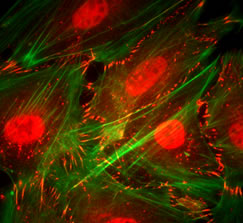
Mouse embryonic fibroblasts captured by Megha Vaman Rao
At MBI we dissect complex behaviors into smaller processes or functional modules. We describe each step within a process using both quantifiable chemical reactions and physical descriptors. From these parameters we build computational models to extract proper representations of how each process works. In this manner we are able to organize modular processes into a mechanistic understanding of their emerging properties and complex phenotypes.
We also apply our fundamental knowledge to solving impactful problems in cancer and regenerative medicine. To help those unfamiliar with mechanobiology to gain a better understanding of the field and relevant cellular processes, we have launched the online, educational resource MBInfo. Read more about current research at MBI.
Curriculum
With an interdisciplinary and highly-integrated team approach to discovery and invention, MBI constitutes a new paradigm in biomedical research and graduate education. Our curriculum is crafted to train innovative and influential leaders for not only in academia but also in R&D-based industry.
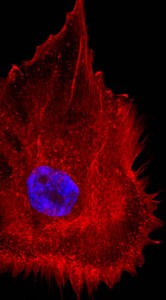
The actin network (red) of a human breast cancer adeno- carcinoma cell, from the Lim Chwee Teck lab.
The mechanobiology curriculum includes four (4) core Courses to introduce the principles of mechanobiology: MB5101- Principles of Mechanobiology (in-depth analysis of biological functions), MB5102- Topics in Mechanobiology (training in critical thinking and presentations), MB5103- Research Seminars in Mechanobiology (training on how to deliver scientific seminars and critically evaluate seminars by others) and MB5104- Integrative Approach to Understand Cell Functions (fundamental concepts and practical approaches in understanding cellular functions). The mechanobiology curriculum also includes one (1) elective course to introduce the principles of mechanobiology: MB5105- Microfabrication for Biologists (basic principles of soft lithography techniques that are classically used by biologists). Students may choose three to four (3-4) elective courses from the many courses offered by the different schools. To help students venture into new disciplines of inquiry, one to two (1-2) undergraduate courses outside the students’ undergraduate training can be taken with a satisfactory or unsatisfactory grade. Students are required to obtain at least 28 Units. To help students develop decision-making and leadership skills, teaching experiences, laboratory rotations and proposal writing are built into the curriculum.
We welcome outstanding candidates who have solid foundations in science (either biomedical or physical) or engineering; with good quantitative, communication and critical thinking skills, adventurous, resourceful, and self-driven, to apply and take part in this research and education journey with us.
Admissions
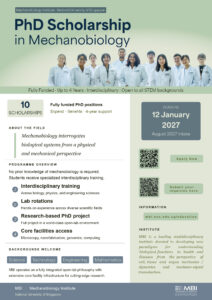
MBI admits new students in August. Applications will be open from 15 August 2026 until 12 January 2027 for the August 2027 intake. Evaluation and interviews will be conducted from the end of January. Please click here for the admissions criteria.
Scholarships
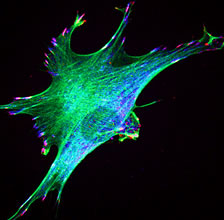
A mouse embryonic fibroblast of the NIH3T3 cell line from the Yasuhiro Sawada lab.
All students admitted to the MBI PhD program will be offered a full scholarship for up to four (4) years. The scholarship covers full tuition fees, with a monthly stipend* of S$3,900 per month for International Students, S$4,400 per month for Singapore Permanent Residents and S$4,800 per month for Singaporeans (plus Central Provident Fund (CPF) contributions pegged at the prevailing employer’s CPF rate). There is also a one-off settling-in allowance of S$1000 and one-off air travel allowance (for 1 one-way ticket on economy class) of up to S$750 for new incoming overseas students’ traveling from their home country to Singapore. In addition, MBI may provide funding support for international conference travel on merit of conference papers to allow the exchange of knowledge and ideas across a broader platform.
Please click here for the terms and conditions of the MBI Scholarship.